You have built this before. The fourth client should not cost what the first one did.
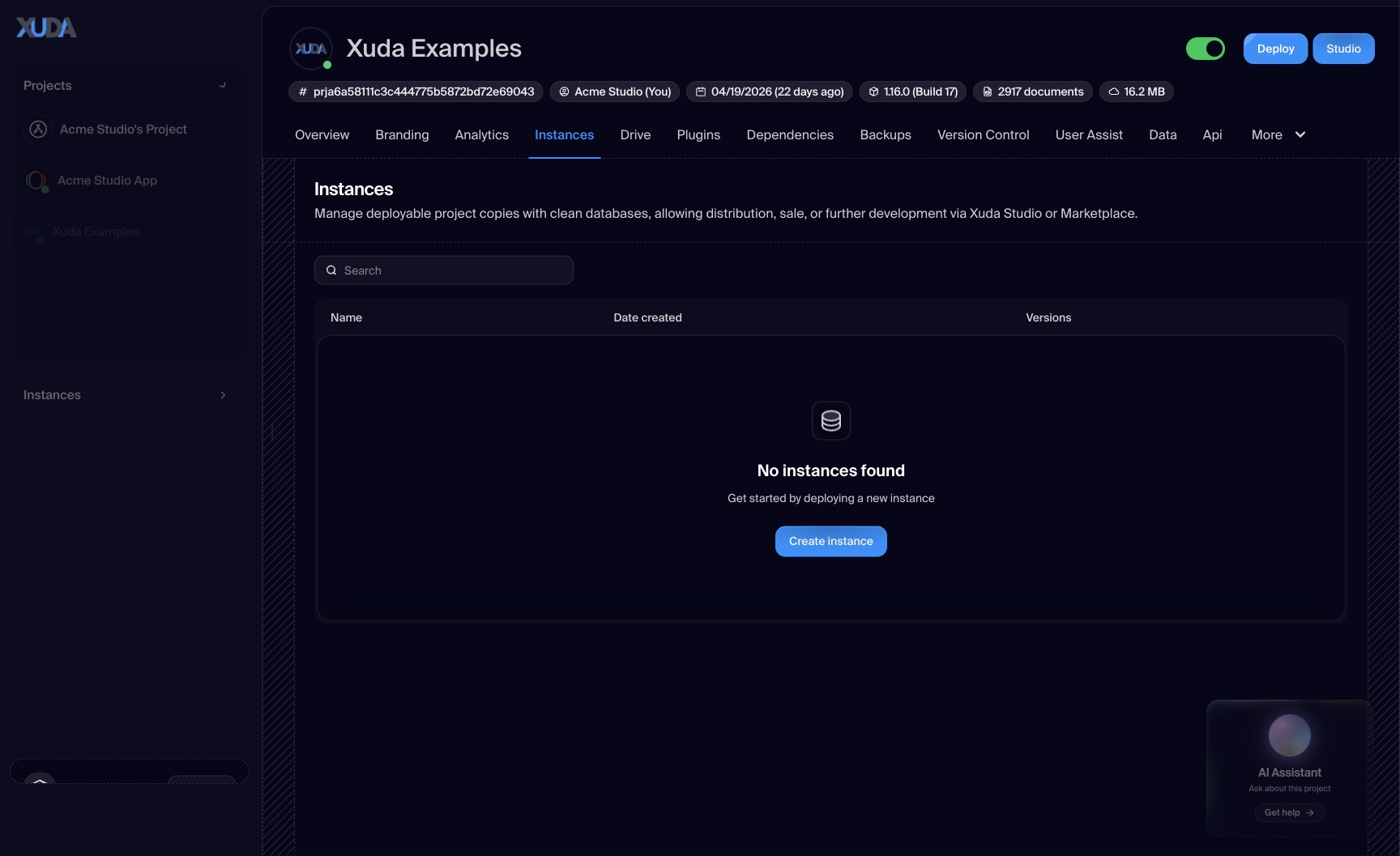
An agency rarely has a building problem. It has a repetition problem. The same booking app, the same intake form, the same admin panel, scoped again, quoted again and delivered again for whoever asks next. Agency is the rung where that stops being a rebuild. You keep one project as the build, and every client gets an isolated copy of it with a clean, pre-configured database of their own, managed from that project Instances tab. You can assign a copy to a client, open Studio access on it so the app can be customised for them, and transfer ownership outright when the engagement ends. It is $399 a month, and what it turns on is the copy itself: the right to hand a client their own running instance of what you already made, and to sell it.
What moving costs, and what it buys.
Team is the shape most agencies are already on: plenty of projects and seats, and no way to give a client a copy. Enterprise T1 is the next stop, and what it adds is not more of the same, it is the network layer.
Team, $149 | Agency, $399 | Enterprise T1, $1,999 | |
|---|---|---|---|
| Client instances you can hand over | 0 | 500, published | 2,000 |
| Publish to the Marketplace | |||
| Register your own plugin into Studio | |||
| Projects | 250 | 1,000 | 5,000 |
| Team seats | 100 | 1,000 | 5,000 |
| Drive | 250 GB | 1,000 GB | 5,000 GB |
| AI credits | 1,600 | 3,500 | 10,000 |
| Datacenter sync and load balancer | |||
| Run it on servers you outsource | Enterprise T2 |
Agency, a month. The rung titled Sale in the plan record itself
Isolated client copies of one build, against 0 on Free, Pro and Team
Things that unlock here and nowhere else: selling on the Marketplace, and registering your own plugin
What Xuda keeps on a sale at the top seller tier, against 20% at the free one
Four moments in an engagement, and what each one runs on.
The list below is not a feature tour. It is the four moments where an agency engagement is actually decided, and three of them are about the end of a job rather than the start of one, which is the part of agency work that software usually ignores. Two of the four are gated on Agency and two are not gated on your membership at all, which is worth knowing before you price the rung.
- Show the client before you ship. A preview deployment generates a shareable link that simulates the app in a device-like environment, so sign-off happens on something clickable. It is its own billing line at $15 a month, and deploy itself is Available from Pro, two rungs below this one.
- Hand the work over for real. The transfer flow covers instances, VPS, external VPS, external apps, static websites and advertising resources, and it reassigns the child records that hang off them. The one condition is on their side, not yours: the recipient must be an active account whose own plan can hold what you are giving them, and that gets validated before ownership flips. If they already hold a Xuda account they arrive on that one rather than a second; if they have never used Xuda at all, the invitation is what creates it, and it is theirs from that moment rather than yours.
- Turn the third delivery into a listing. A marketplace listing is created in three steps, Configure, Instance setup and Finalize. Publishing is validated rather than waved through: at least three keywords, a description between 500 and 3,000 characters, a name between 5 and 50, at least one image, and a price between $5 and $100,000. Your take rate depends on the seller tier you pick, from 20% on the free one down to 5% on Scale.
- Register your own plugin into Studio. Agency is the membership that lets you register a plugin at all, and a plugin the AI builder creates for you is registered private, in its own npm scope, at version 0.1.0. Making it public is a second, separate gate: without an active Stripe Connect seller account that method returns a 403.
Different shops, same shape: build once, deliver many times.
Agency is not one business. It is six shops, and five of them share one problem. A dev shop hands the same architecture to a new client every quarter. A marketing agency runs a site, an inbox and a support queue for twenty clients at once. An integrator never builds the whole thing, only the wiring. A reseller puts someone else name on the login screen. A franchise operator runs one app in forty locations that must not see each other data. Find the one that describes your week.
What the week actually looks like.
Three of those rows carry most of the volume. Here is the concrete job each one does, and the surface it does it on.
- 01
The dev shop delivers the fourth one
Build the app once as a project. Deploy an instance per client, each with its own clean database and structure. Before sign-off, put a preview deployment in front of them so they click through a device-like simulation on a shareable link rather than reading a changelog, at $15 a month for that deployment. When the engagement ends, submit a transfer request and the instance becomes theirs outright, along with its child records. You are not holding their app hostage to keep the retainer.
- 02
The reseller ships it wearing someone else name
Configure the Branding tab on the project: brand colour, accent colour, logo, and whether the auth layout sits to the side or in the centre. That is what a user meets at the login screen, at $80 a month. Then decide how the copy travels. Up to 500 instances can live under your account for you to sell directly, or you register your own plugin into Studio and list a finished build on the Marketplace, where every buyer is provisioned their own private instance automatically and payouts land in your own Stripe account.
- 03
The franchise operator opens location forty
One instance per location, all stamped from the same build, so location forty sees only its own data and head office does not have to trust a filter to keep it that way. Each location gets a User Group deployment, a shareable or internal access link so staff log in as themselves, at $35 a month per group plus $9 per member. Head office and every location manager sit on the same account: Agency carries 1,000 team seats against 100 on Team. When a store changes hands, transfer that one instance to the incoming franchisee.
Six things to know before you put $399 a month on a card.
- The 500 instance cap is published in the plan record, and no enforcement site for it turned up in the platform source. Projects and team seats both have a real one that refuses with the count. Treat 500 as the number on the price list rather than as a wall somebody has been watched hitting.
- Marketplace is two gates wearing one name. The Agency membership lets you register a plugin and create a listing. Actually selling needs a seller tier on top, from free through Scale at $149 a month, and publishing a plugin publicly returns a 403 without an active Stripe Connect seller account. Budget for both lines, not one.
- This is where an Agency plan runs out: datacenter sync and load balancer both read N/A on Agency and only flip to Available at Enterprise T1, at $1,999. If a client needs every region behind one public endpoint, that is not a bigger Agency plan, it is a different one.
- A transfer can be refused for reasons that are nothing to do with you. The receiving account has to be active and its own plan has to be able to hold the resource, and that is checked before ownership moves. A client sitting on a free account cannot receive an instance.
- Version control here means revisions and rollback, and nothing else. There is no staged rollout: a normal build assigns the staged and the live number the same value, so you cannot put a client on the new version and leave the other four behind on purpose.
- The integrator door is wide but flat. An API key reaches 331 public CPI methods, and the same key drives the /mcp server, but all 331 arrive as one unpaginated, ungrouped list, and the only way to narrow it is to issue a narrower key. There is no REST SDK either: the sample tabs are a literal fetch and a literal curl_init.
Four questions, asked on every one of these pages
The same four, so you can compare this page against the other four doors without rereading anything.
Price it against the next four deliveries, not the first one.
Agency is $399 a month and it is priced against repetition. If you deliver the same build twice a year it is expensive. If you deliver it monthly, or you sell it, or you run it in forty locations, the arithmetic stops being close. The rest of what an agency spends here is per site, per domain and per deployment, and none of it is bundled into the rung.